


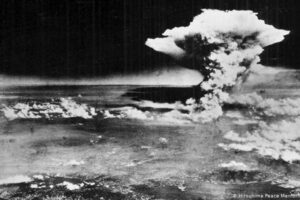
 DW — Keiko Ogura intends to commemorate August 6 in peaceful contemplation alongside the river at Peace Park — but will never talk about her experiences with her own children.
Keiko Ogura had celebrated her eighth birthday just two days before the atomic bomb was dropped on Hiroshima on August 6, 1945. She was standing outside her home just 2.4 kilometers (1.49 miles) from the hypocenter of the detonation of the first nuclear weapon to be used in war but, miraculously, survived.
And while physically she is still a fit and healthy 83-year-old today, the toll that the bomb took on her was internalized and left unspoken until the death of her brother from cancer. Since 1980, Ogura has been a regular speaker at commemorative and educational events linked to the bomb, although she still will not talk to her own children about her experiences.
It is, she says, too much for them to hear. Ogura tells me that the bomb is the one thing that she will never discuss with her children. And she can trace that reluctance to an incident in the immediate aftermath of the attack.
Survivor of the bomb
“I was standing outside my house when the bomb detonated, but I was shielded by a storehouse,” she told DW. “I was blown over and knocked senseless by the blast, and when I opened my eyes again all the houses around me were damaged and on fire.”
Remarkably, all her family survived the initial blast, although one brother had been far closer to the hypocenter and later contracted cancer and died.
“I had some burns, but nothing too serious,” Ogura said. “Our home was damaged but not completely destroyed, so we took in people who had been injured.” Local residents had been instructed that in the event of an air raid, they were to move to the grounds of temples and shrines in the hills surrounding the city. A Shinto shrine stood on a hill close to Ogura’s home and she describes a constant stream of disfigured and desperate people heading for its sanctuary. Many died on the way and their bodies lined the roads.
“I was shocked to see them,” she said. “There were two people who were badly hurt, one grabbed me by the ankle and they pleaded with me to give them water. So I did. I did not know that we were not meant to. Both of them died in front of me.
“I kept that moment a secret from everyone else because I felt so much guilt at giving them water. So I suffered from that memory for years. It’s something I cannot tell my own children.”
Another memory is of the countless people who died around her home. Her father told her not to go to the local park, but she was curious and climbed a low hill from where she could see her father and other survivors gently lifting the bodies onto funeral pyres that burned around the clock.
Enola Gay payload
The “Little Boy” uranium bomb was dropped on Hiroshima from the US Air Force B-29 Superfortress Enola Gay at 8.15 a.m. on August 6, 1945. The bomb detonated with an energy equivalent to 16,000 tons of TNT about 580 meters (1,902 feet) above the distinctively shaped Hiroshima Prefectural Industrial Promotion Hall, a structure now known as the Atomic Bomb Dome and registered as a UNESCO World Heritage Site.
An estimated 80,000 people died in the initial blast from the bomb and the firestorm that it triggered, with intense neutron and gamma radiation lethal to a radius of 1.3 kilometers. A further 70,000 were injured, while at least 6,000 people survived the blast and fire but later succumbed to radiation injuries. The vast majority of the victims were civilians. US military surveys shortly after the war determined that 4.7 square miles (12.2 square kilometers) of the city had been destroyed.
Read more: How the Japanese view Obama’s Hiroshima visit
A recent study by Kyodo News found that 78% of survivors of either the bombing of Hiroshima or Nagasaki, which took place on August 9, find it difficult to talk about their experiences. More than 40% of the survivors said they had never shared their memories of the bombings.